

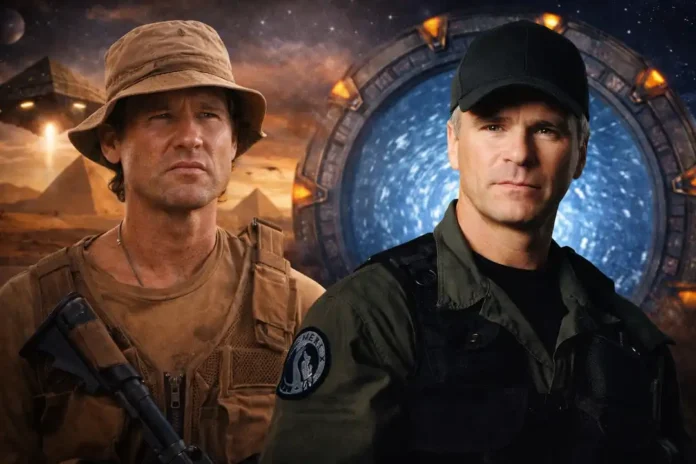

When Stargate arrived in cinemas in 1994, it didn’t look like the beginning of a television empire. It looked like a classic 90s blockbuster gamble. It was a big original sci-fi idea, had sizeable budget, recognisable stars like Kurt Russell and a clear sense that this story was only just beginning.
And that was deliberate. Stargate was designed from the outset to launch a movie trilogy, not a long-running TV universe. What followed instead was one of the most unexpected pivots in sci-fi history.
Keep reading to find out more about the original plan and why it ended up switching to TV, but if you like Stargate (or movies in general) then maybe check out the full podcast episode, available wherever you get your pods. Or right here in our player.
A Trilogy Was the Original Plan
Director Roland Emmerich and producer Dean Devlin conceived Stargate as the opening chapter in a three-film arc. The first movie would establish the mythology: ancient gods as parasitic aliens, humanity’s forgotten role in a vast interstellar network, and the Stargate itself as a literal gateway to countless worlds.
The planned sequels (which they planned on bringing back Spader and Russell for) would have expanded that universe dramatically – exploring other Stargates, other civilizations, and the wider consequences of humanity rediscovering this technology. In other words, the groundwork for a sprawling franchise was already there. It just wasn’t meant to live on television.
Financially, Stargate performed well at the cinema. Against a budget of around $55 million, it earned close to $200 million worldwide. That’s a solid hit for an original sci-fi film in the mid-90s. But its reception was uneven. Critics were mixed, praising the ambition and effects while questioning the pacing and character work.
The combination of commercial success without overwhelming critical acclaim put the franchise in an awkward position. A sequel was viable, but not guaranteed. Meanwhile, television was undergoing a quiet sci-fi renaissance.
CLICK NEXT: 10 Movie Aliens That Defined the VHS Era

Why Stargate Moved to TV Instead
The pivot to TV wasn’t initially part of Emmerich and Devlin’s plan. But after the box office success in’94 they went on to do it again with Independence Day in ’96.
Meanwhile the TV show was being prepared for launch in 1997 as Stargate SG1. The rights were owned by MGM which then put the sequels on hold because of the small screen success.
And the switch to TV made strategic sense. Television offered something the film format couldn’t: TIME.
The core ideas behind Stargate – linguistics, mythology, alien politics, moral ambiguity – were arguably too large for a two-hour movie structure. Television allowed those concepts to breathe, develop, and evolve organically. It also solved one of the film’s biggest issues, which was the depth of its characters.
Where the movie struggled to balance spectacle with emotional engagement, television could slow down, focus on relationships and let the mythology grow without the pressure of blockbuster expectations.
When Stargate SG-1 premiered in 1997, it continued the story (albeit with different actors taking on the lead roles as the movie characters, weirdly) but also redefined the franchise. Over time, the TV shows expanded the lore far beyond anything the original trilogy plan could realistically have achieved.
Ironically, the movie’s role became foundational rather than definitive. It provided the mythology, the tech, and the premise but the franchise’s identity was shaped elsewhere. For many fans, Stargate is remembered less as a single film and more as the launchpad for something far bigger.
YOU MIGHT LIKE: The 11 Most Underrated Movies of the 1980s That Deserve A Rewind

What Was Lost And What Was Gained
The shift from cinema to television came with trade-offs. A film trilogy might have delivered higher budgets, larger-scale spectacle and a more cohesive visual identity. But instead Stargate became episodic, character-driven, and at times uneven.
But it also gained longevity, flexibility, and a devoted fanbase that stuck with the franchise for years. Few sci-fi properties from the 1990s can claim that level of sustained relevance.
In hindsight, Stargate’s greatest strength may have been its unfinished nature. The film feels like the opening chapter of a much larger story because it was meant to be. Television simply became the place where that story could finally be told properly.
What started as a planned movie trilogy became one of the most expansive sci-fi universes of its era.
It may have been down to adaptation and evolution rather than design but in doing so Stargate proved that sometimes the best franchises aren’t the ones that stick to the plan, but the ones that know when to change course.
While there has been talk of a reboot for years, with various updates in 2006 reconfirming sequel plans and then in 2014 as a reboot.
In 2018 it was pretty much officially abandoned by Devlin. Nothing would happen for another 8 years. But it does seem we’re about to get a new Stargate offering in 2026..
READ NEXT: The Moment That Made Me Rethink (and Love) the Star Wars Prequels