

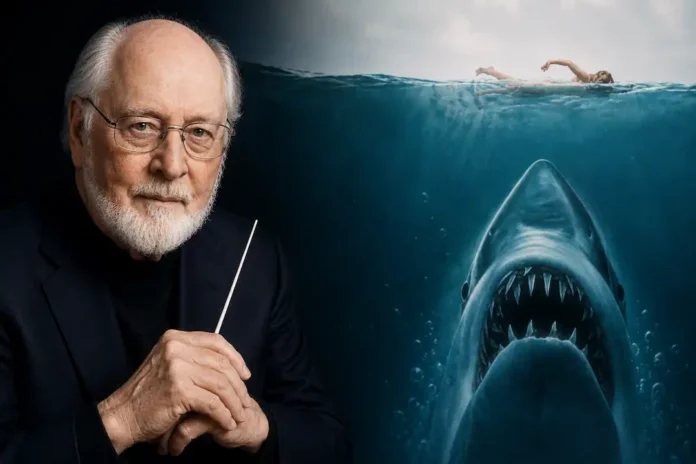

When Steven Spielberg first went to John Williams with Jaws, he expected the music to be strange and complicated, writes Seara Kaye from Berklee College of Music.
Instead, Williams played two notes for him. E and F, over and over. Dun-dun-dun-dun.
Spielberg laughed. He’d always thought John Williams had a great sense of humor. But Williams had found his melody, and he insisted on it.
“Play it again,” Spielberg said, and Williams did, again and again. Eventually, Spielberg agreed to the melody, and Jaws became the famous score we know today.

Why the Jaws motif hits so hard
But why does it work so well? What about it sparks fear and curls toes in the water?
John Williams rose from a legacy of classical composers. You can hear in those two notes echoes of Stravinsky’s Rites of Spring, Dvorak’s New World Symphony, and Mussorgsky’s Pictures at an Exhibition.
He borrows the idea of leitmotifs (recurring pieces of music associated with a certain character) from Prokofiev and Wagner.
These composers are famously weird and wacky – just look up the Wagnerian Cult or Stravinsky’s concert riots.
RELATED: The 25 Greatest Movie Soundtracks of All Time
Williams goes primal with theory
Williams had the background to write an atonal, out-there score. Instead, he took these ideas and pared them back to their most primal form.
There’s an idea in music theory called leading tone. Which basically suggests a tense note should resolve to a calmer one.
Jaws flips that around, leaving us literally hung to dry on a suspenseful note. The whole main theme never resolves that melody – we’re oscillating between two notes like a swimmer dog-paddling for shore.
MOVIE MUSIC: Iconic music returns in Masters of the Universe title reveal
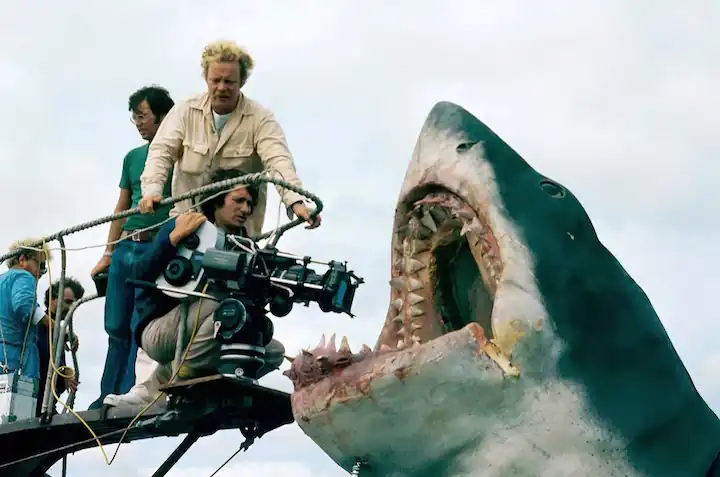
Story over ego means Williams always wins
Here enlies the musical genius of John Williams. He has the training to write wildly complex music, but his most important goal is to serve the story.
There is no need to make Jaws more convoluted than it is–the most powerful ideas are often simple. A predator, its prey, two notes that tug back and forth the whole film.
The audience holds its breath when the shark first emerges with those low, relentless strings, and they don’t exhale unless the music tells them to.
Even more incredible, Williams understood the timing of his music.
There are moments towards the end of the film where the shark appears, and the predator motif is no longer there.
Williams set the expectation of the melody, and takes it away, leaving us itchy in the silence. Then–bam! The shark attacks and the music does, too.
So this summer, when you go to the beach, maybe you’re a little more hesitant diving in.
You can thank John Williams for that. That’s what two notes, in all their complexity and simplicity, can do.
- Seara Kaye is studying Film and Media Scoring at Berklee College of Music. She has already composed for a variety of movies and animations and has two albums – “Sara With an ‘E” and “Rhymes With Tiara” – out on all streaming platforms. Find out more about her here or find her Instagram at @searakayemusic.